
75. A philosopher's day job
Thoreau's Pencils
Henry David Thoreau
Concord, MA, 1821-1854
Ubiquitous in modern American note-taking, pencils are less common in other times and places. The English term dates from the 14th century to designate a fine painter's brush, a usage that persisted into the modern period. The pencil "of black lead" was likely developed in the mid-sixteenth century, after the discovery of graphite in England, and was alreadydescribed by Conrad Gessner in 1565. But graphite pencils were used more often to draw than to write. The earliest notes in pencil that survive date from mid-seventeenth-century England, and some of them have been traced over in pen. For example, Royal Society virtuoso John Evelyn (1620-1706) took a few of his abundant notes in pencil; some were traced over in ink by contemporaries, including John Aubrey (see Elizabeth Yale, Manuscript technologies: science and the culture of writing in early modern Britain (Ph.D. dissertation, Harvard University, 2008). p. 162).
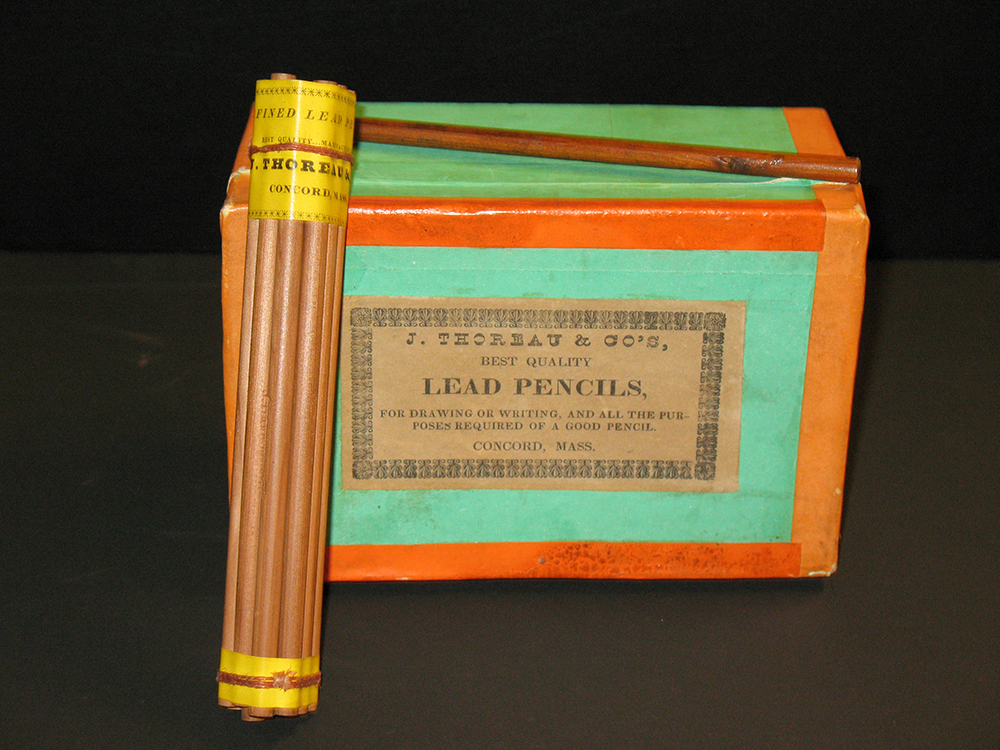
The pencils you see here were manufactured by the company founded in Concord, Mass., by John Thoreau and Charles Dunbar after the latter discovered graphite in New Hampshire in 1821. Henry David Thoreau, son of John Thoreau and himself a proprietor in the company, contributed an improvement to the pencil made from New England graphite by suggesting the use of clay as a binder, to compensate for the lesser quality of the local compared to English graphite.
Each box held 144 unsharpened pencils (1 gross) in 12 packets of 12 unsharpened pencils each. Pencils appear nowhere in Henry David Thoreau’s penciled list of what he brought to the Maine Woods.
Henry David Thoreau seemed to think of everything when he made a list of essential supplies for a twelve-day excursion into the Maine woods. He included pins, needles, and thread among the items to be carried in an India-rubber knapsack, and he even gave the dimensions of an ample tent…. He wanted to be doubly sure to be able to start a fire and to wash up, and so he listed: “matches (some also in a small vial in the waist-coat pocket); soap, two pieces.” He specified the number of old newspapers (three or four, presumably to be used for cleaning chores), ….
… [h]e advised like-minded observers to carry a small spyglass … a pocket microscope … tape measure … and paper and stamps, to mail letters back to civilization.
But there is one object that Thoreau neglected to mention, one that he most certainly carried himself. For without this object Thoreau could not have sketched … fauna…. Without it he could not label his blotting paper … or his insect boxes … record measurements … write home … make his list. Without a pencil Thoreau would have been lost in the Maine woods.
According to his friend Ralph Waldo Emerson, Thoreau seems always to have carried, “in his pocket, his diary and pencil.” So why did Thoreau … neglect to list even one among the essential things to take on an excursion? Perhaps the very object with which he may have been drafting this list was too close to him, too familiar a part of his own everyday outfit, too integral a part of his livelihood, too common a thing for him to think to mention. (Henry Petroski, The Pencil, 1989, pp. 3–4)
English. Wood, graphite.
Houghton Library. MS Am 2967 and 2968. HOLLIS Catalog: 012567424